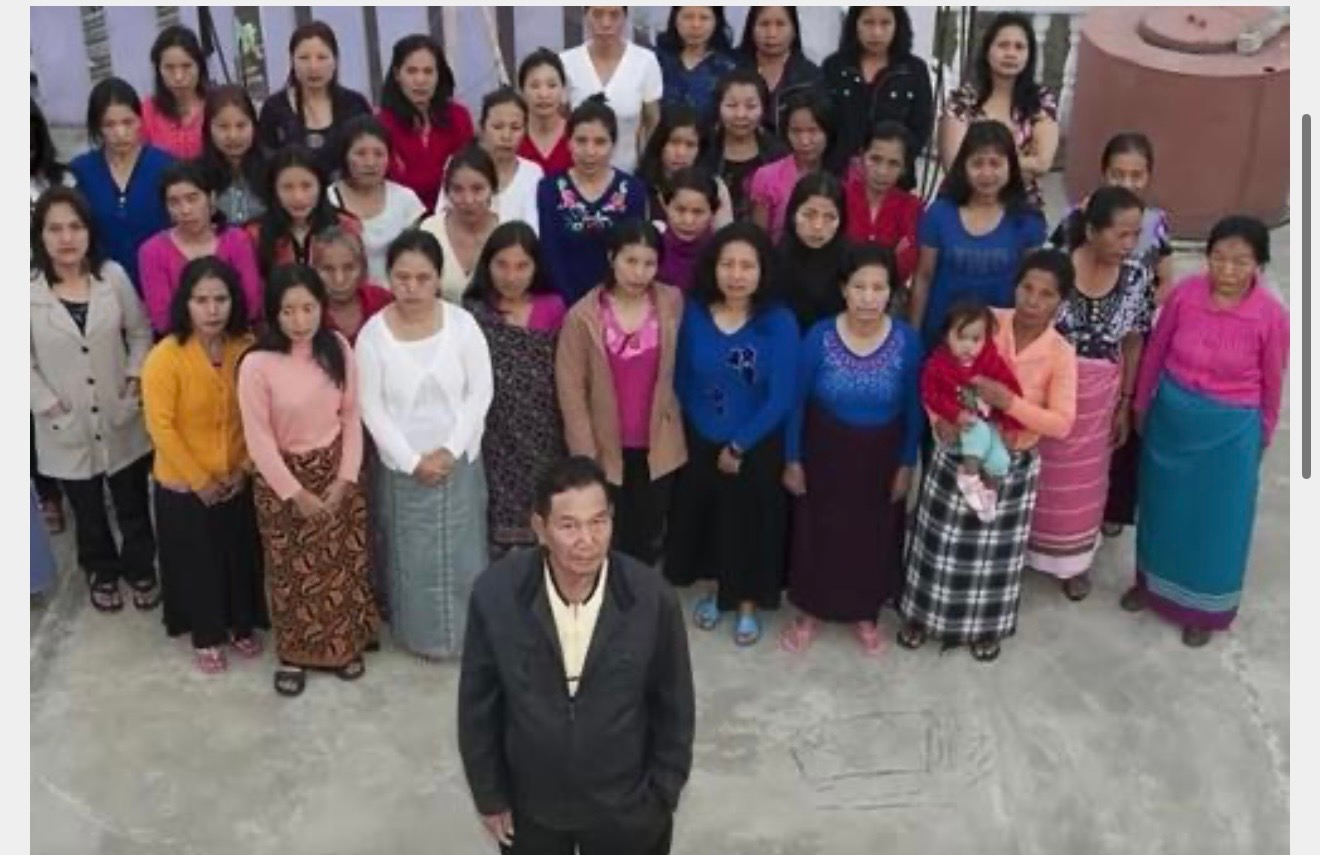
An Indian man with 39 wives, 94 children, and 33 grandchildren is not convinced that his family is complete. In fact, Ziona Chana once said that he was ready to marry again, which would bring the number of his wives to an astonishing 40. Even after a 40th wedding, who is to say he would stop there? According to his own statements, he has always been open to expanding his family even further if the opportunity arose.
Ziona Chana lived with his wives, children, and grandchildren in the Indian state of Mizoram, located in the country’s remote northeastern region. The family became internationally famous for being one of the largest households in the world, with more than a hundred people living together under a single roof. While most people can hardly imagine managing a family of even ten members, the Chana household functioned almost like a small village, with every member playing a role in keeping daily life running smoothly.
According to Reuters, the entire family lived in a massive four-story house consisting of approximately 100 rooms. The building was carefully organized into different sections to accommodate such a large number of residents. Despite the extraordinary size of the household, the family had developed a structured way of living together.

Ziona had a private bedroom reserved exclusively for himself. His wives slept in shared dormitory-style rooms located close to his quarters. Elsewhere in the enormous house were additional rooms for his sons, their wives, and their children. The layout of the residence allowed several generations of the family to live comfortably while remaining under the same roof.
One of the most important areas of the home was the communal kitchen. Instead of each family preparing separate meals, everyone shared the same cooking facilities. Every day, enormous quantities of food had to be prepared to feed more than a hundred people. Cooking for such a large family required careful planning, teamwork, and strict organization.
The responsibilities inside the household were divided among family members. Each person had specific duties that contributed to the smooth operation of daily life. For example, the daughters were responsible for washing clothes, cleaning the house, and performing many household chores. The sons cared for livestock, worked in agriculture, and handled other physically demanding tasks that helped support the family’s self-sufficient lifestyle.
Meanwhile, Ziona’s 39 wives took charge of preparing meals. Feeding so many people every day was no easy task. According to reports, the family consumed about 200 pounds of rice and 130 pounds of potatoes every single day, in addition to large amounts of vegetables, meat, eggs, and other food. Preparing breakfast, lunch, and dinner for such an enormous household required hours of work and close cooperation among the women in the kitchen.

Although this style of family life may seem extraordinary or even unbelievable to many people around the world, it was considered completely normal within the religious community known as the Chana sect. The group, led by Ziona Chana, practiced beliefs that allowed polygamy and encouraged large families. According to Reuters, the religious sect was founded in 1942 and developed its own customs and traditions that differed from mainstream society.
Because of his leadership role within the community, Ziona became well known throughout the region. Local residents often said they would regularly see him traveling with several of his wives at the same time. Some claimed he particularly enjoyed being accompanied by around eight wives whenever he went out in public. Such scenes attracted considerable attention from visitors and journalists alike.
Supporting such a large family naturally required significant financial resources. According to reports, the household relied on a combination of its own agricultural production, livestock, family businesses, and donations from followers of the religious community. These combined resources enabled Ziona and his family to provide food, clothing, and shelter for everyone living under the same roof.
The family worked together to remain as self-sufficient as possible. Many of the food products they consumed were either grown on their own land or produced through their farming activities. This reduced dependence on outside supplies and helped sustain the enormous household.

Ziona married for the first time while he was still very young. He was only 17 years old when he married his first wife, who was 20 at the time. Over the following decades, the size of his family expanded rapidly. The number of wives continued to increase as the years passed, eventually making him one of the most well-known polygamists in the world.
In one interview, Ziona recalled just how quickly his family had grown. According to Reuters, he said, “Once I married ten women in a single year.” That statement astonished many people and further highlighted the unusual nature of his family life.
Despite the enormous responsibility of caring for dozens of wives and well over a hundred descendants, Ziona insisted that he viewed his life as a blessing rather than a burden. He repeatedly expressed pride in his family and said that looking after so many people gave his life meaning and purpose.
Speaking to journalists, he declared:
“Even today, I am ready to expand my family and marry again and again. I have so many people to care for that I consider myself a fortunate and happy man.”
His remarkable story attracted worldwide media attention and was featured in numerous international publications and television programs. People from many different countries became fascinated by the logistics of everyday life inside such a gigantic household. Visitors often traveled to Mizoram simply to see the famous four-story home and learn how so many people managed to live together peacefully.

For many observers, the Chana family represented more than just an unusually large household. It sparked discussions about cultural traditions, religious beliefs, family structures, and the different ways communities organize themselves around the world. While many people viewed the lifestyle with surprise or disbelief, others saw it as an example of how customs can vary dramatically across cultures.
The family’s residence itself became something of a local attraction. Its 100-room design reflected the practical needs of housing multiple generations together while maintaining a sense of order. Every corner of the building served a purpose, from the communal sleeping areas and family rooms to the large kitchen and shared spaces where daily activities took place.

Although many people may never fully understand or agree with the concept of such an enormous polygamous family, there is no denying that Ziona Chana’s household became one of the most extraordinary examples of communal family living in modern history. His life, his beliefs, and the unprecedented size of his family continue to capture public attention, illustrating just how diverse human societies and family traditions can be across the globe.