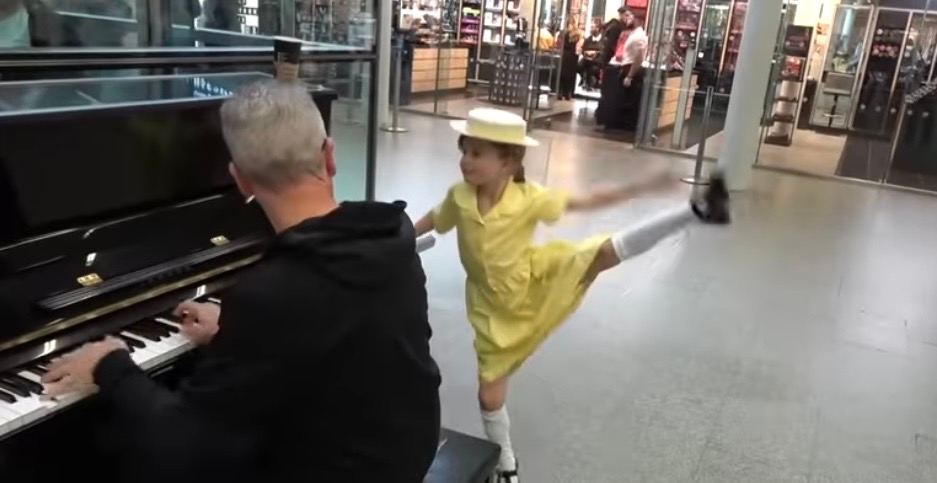
What started as an ordinary day at a busy London train station unexpectedly became a charming little performance that captured the attention of everyone nearby.
The station was filled with the familiar sounds of commuters rushing from one platform to another, people checking their phones, carrying bags and hurrying toward their destinations. Amid all the noise and movement, however, one sound stood out: the unmistakable melody of music from Mary Poppins being played on a public piano.
The pianist had no idea that his performance was about to attract a very special audience.
Among the people passing through the station was a six-year-old girl named Zoe, who was visiting as part of a school trip. When she heard the familiar melody, something immediately caught her attention. Instead of continuing with the group, she stopped and listened.
The music was clearly recognizable to her, and for a moment, Zoe simply stood there taking it in. Then, almost as naturally as if she were in a dance studio, she decided to move to the music.
She put down her bag and began dancing.
There was no rehearsal. There was no planned performance and certainly no stage. There was simply a little girl, a piano and a melody she knew and loved.
Zoe danced with remarkable confidence for someone so young. She did not appear concerned about the people around her or about whether anyone was watching. She simply followed the rhythm and allowed the music to guide her movements.

The pianist soon noticed what was happening.
Rather than stopping, he continued playing and appeared to embrace the unexpected moment. The music and Zoe’s movements began to feel like an impromptu collaboration between two performers who had never planned to share the same stage.
As Zoe continued dancing, more people nearby began to notice.
What had initially been just another moment in a crowded railway station slowly turned into a small gathering of spectators. Commuters who had been focused on getting somewhere stopped for a moment to watch. The contrast was striking: people rushing through their busy day suddenly pausing to enjoy the spontaneous performance unfolding in front of them.
Zoe, meanwhile, seemed completely comfortable.
She continued dancing with enthusiasm, responding to the music and enjoying every second of it. Her confidence made the moment particularly memorable. Instead of being intimidated by the public setting, she seemed to treat the station as though it were her own little stage.
The pianist also adapted to the unexpected situation, allowing the performance to develop naturally. Neither performer knew exactly where the moment was going, but that was part of what made it special.
There was something wonderfully uncomplicated about it.
No elaborate production was needed. There were no costumes, no rehearsals and no spotlight. The station’s public piano provided the music, while Zoe supplied the energy and imagination.

After the performance, the pianist had an opportunity to speak with Zoe and learn more about the young dancer who had suddenly appeared beside his piano.
He discovered that Zoe had recognized the Mary Poppins music almost immediately. The melody was familiar to her, and she explained that she loved the music.
Her connection with music did not stop there. Zoe also revealed that she took part in dance and music activities at school. Suddenly, her spontaneous decision to dance made even more sense. What looked to passersby like an impulsive burst of energy was also an expression of something she genuinely enjoyed.
For Zoe, the moment seemed simple: she heard music she liked and wanted to dance.
For everyone watching, however, it became something much more memorable.
The encounter is a beautiful example of how music can bring strangers together, even in places where people normally have little reason to interact. A train station is usually associated with schedules, departures, arrivals and hurried journeys. Yet for a few minutes, the usual rhythm of the station changed.
People stopped rushing.
They watched.
They smiled.
And a little girl danced.
There is also something refreshing about Zoe’s complete lack of self-consciousness. At six years old, she was not worried about whether her movements were perfect or whether strangers might judge her. She heard a song that made her happy and simply responded to it.
That kind of spontaneity can be easy to lose as people grow older. Adults often think twice before dancing in public, singing along to a song or doing something unexpected because they become increasingly aware of how they might appear to others.

Zoe did not seem to have that hesitation.
She simply followed the music.
The pianist’s willingness to continue playing helped transform her spontaneous reaction into a genuine performance. Together, they created something that could never have been completely planned because its charm came precisely from the fact that it happened naturally.
The story is also a reminder that memorable moments can appear in the most ordinary places.
A railway station may seem like an unlikely setting for a magical performance, but all it took was a familiar melody and someone willing to stop and listen.
Zoe’s dance may have lasted only a short time, but it turned an ordinary day into an experience that those watching were unlikely to forget. Her enthusiasm reminded everyone around her that sometimes the best moments are the ones nobody planned.
There was no grand stage, no ticketed audience and no elaborate choreography.
There was just a six-year-old girl who heard a Mary Poppins melody, put down her bag and decided to dance.
And for a few wonderful minutes, a busy London train station became her stage.
You may also like this👇📚