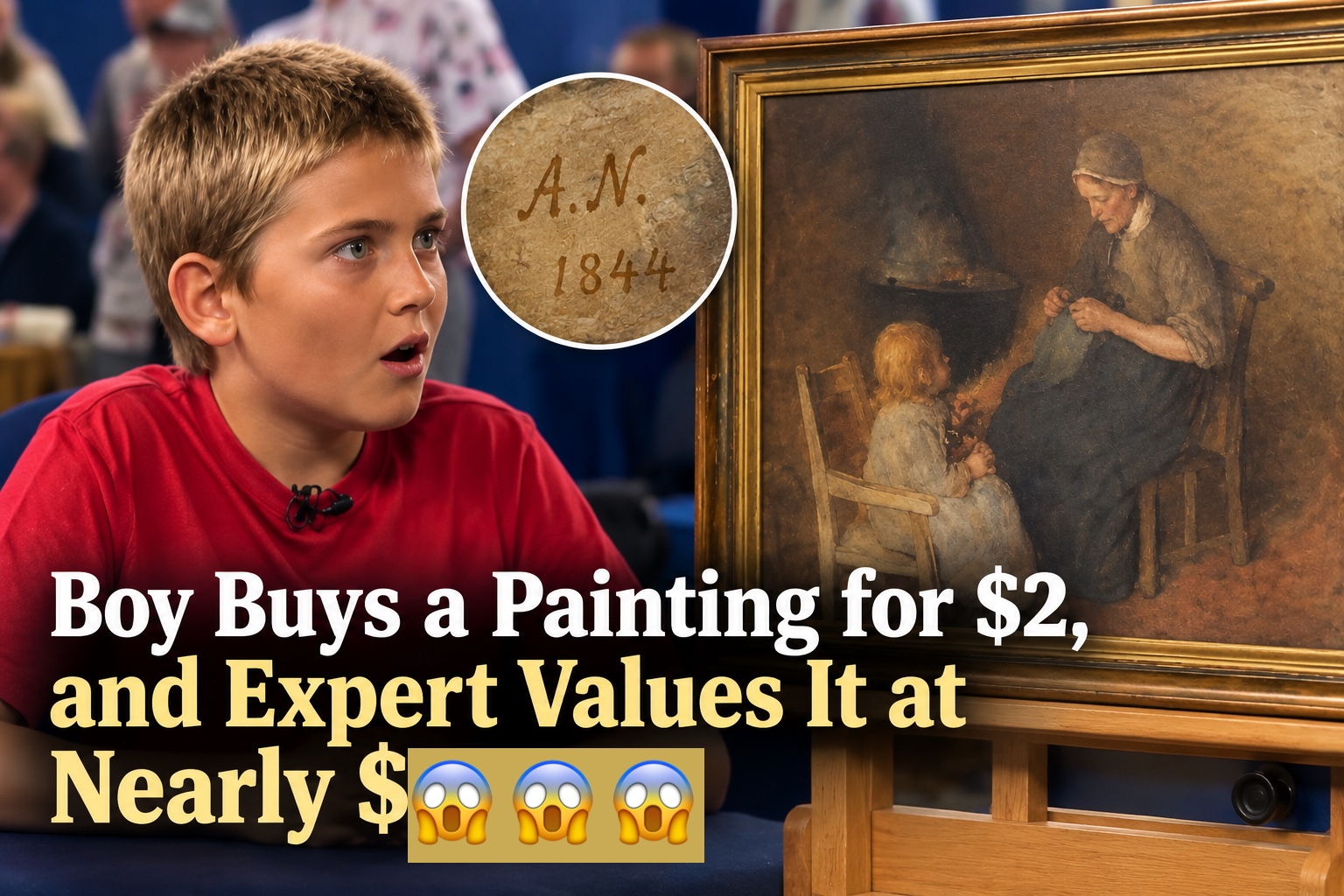
They say that the value of any object is ultimately determined by how much someone is willing to pay for it. One young boy from New Jersey discovered just how true this market principle can be when he appeared on an episode of the popular antiques program Antiques Roadshow.
What began as an ordinary purchase at an auction turned into an unforgettable lesson in art, money, and the value of trusting your instincts.
The remarkable story took place in 2014, when a boy who wished to remain anonymous brought a painting to the show and asked David Weiss, a professional auctioneer and one of the program’s experts, to determine its value.
The young guest explained that he had paid just $2 for the artwork. He had no idea that his inexpensive purchase might be worth considerably more than he had ever imagined.

During his conversation with Weiss, the boy described how the painting had come into his possession. He had first spotted it at an auction he attended with his father.
The artwork immediately caught his attention because it depicted a woman with a child. Something about the scene appealed to him, and he quickly decided that he wanted to own it.
Unlike many children his age, the boy already had an interest in buying and selling antiques. He enjoyed visiting local flea markets and auctions, searching for unusual objects that might be worth more than their asking prices.
Among the items that caught his eye were interesting paintings and silver tableware, which he occasionally managed to resell for a small profit.
His father, however, was not particularly enthusiastic about his son’s decision to purchase this particular painting. Perhaps he simply could not see what made the artwork so special.
Nevertheless, the boy stood by his choice and insisted on buying it. Eventually, they managed to secure the painting for the remarkably low price of just $2.
It was a decision that would soon prove far more rewarding than anyone in the family had anticipated.
When David Weiss began examining the artwork, he took a closer look at its style, historical characteristics, and signature. His investigation led him to conclude that the painting had been created in 1844. He also managed to decipher the initials written in watercolor, identifying the artist as Albert Neuhuys, a well-known Dutch painter.
For the young collector, this discovery was already exciting. He had purchased a painting for the price of a small snack, only to learn that it was a genuine work of art dating back to the nineteenth century.

Weiss explained that the painting was an excellent example of the artistic traditions of its period. During that era, watercolor artists frequently explored scenes of women with their children, creating intimate compositions that captured everyday life and the emotional connection between family members. Such works could appeal to collectors interested in both historical art and the distinctive techniques of nineteenth-century painters.
But the most exciting part of the evaluation was still to come.
After completing his examination, Weiss asked the boy how much he thought the painting might be worth. The young collector considered the question and offered his estimate: at least $150.
Weiss agreed that the painting was worth that much, but he encouraged the boy not to underestimate his discovery. According to the expert, artworks from the same period and in a similar style could attract buyers willing to pay between $1,000 and $1,500.
Then came the valuation that changed the entire conversation.
Weiss announced that, in his opinion, the boy’s particular painting should be valued at $1,498.
The young guest could barely contain his excitement. Learning that an object purchased for only $2 might be worth nearly $1,500 was an extraordinary surprise. The difference between the original purchase price and the expert’s estimate was enormous, and his reaction made it clear that he had never expected such a result.
When Weiss asked him what he thought about the valuation, the boy answered with an enthusiasm that brought a smile to the expert’s face.
“I think I’m going to get rich!”
Weiss shared in the boy’s excitement and suggested that he had good reason to feel optimistic. If he continued finding valuable objects at bargain prices, his interest in antiques could eventually become a profitable pursuit.
The boy, for his part, already had an idea of what he wanted to do in the future. He hoped to become an art dealer, turning his passion for searching through auctions and flea markets into a profession.
His story offers a delightful reminder that valuable discoveries do not always come with impressive price tags. Sometimes, an object that others overlook can turn out to be a hidden treasure in the hands of someone who recognizes its potential.
Of course, not every inexpensive painting will become a valuable collector’s item. Identifying an artist, establishing a work’s age, and assessing its condition and market demand all require knowledge and experience. An expert valuation also does not guarantee that a painting will actually sell for the estimated amount.

Still, this young boy had already demonstrated something that many aspiring collectors spend years learning: curiosity, patience, and a willingness to look beyond an object’s initial appearance can sometimes lead to remarkable discoveries.
For just $2, he had acquired more than an old painting. He had gained a memorable experience, discovered the excitement of art collecting, and received an encouraging glimpse of a possible future career.
And while his father might initially have questioned the purchase, the television appearance offered a rather convincing argument in the boy’s favor. After all, not every child can walk into an auction with a couple of dollars and walk away with a painting that an expert estimates to be worth nearly $1,500.
Whether the young collector eventually became a successful art dealer remains a separate question. But his unexpected discovery on Antiques Roadshow showed viewers that sometimes the most interesting treasures are hiding in plain sight, waiting for someone curious enough to give them a second look.
You can also read this 📚👇👀