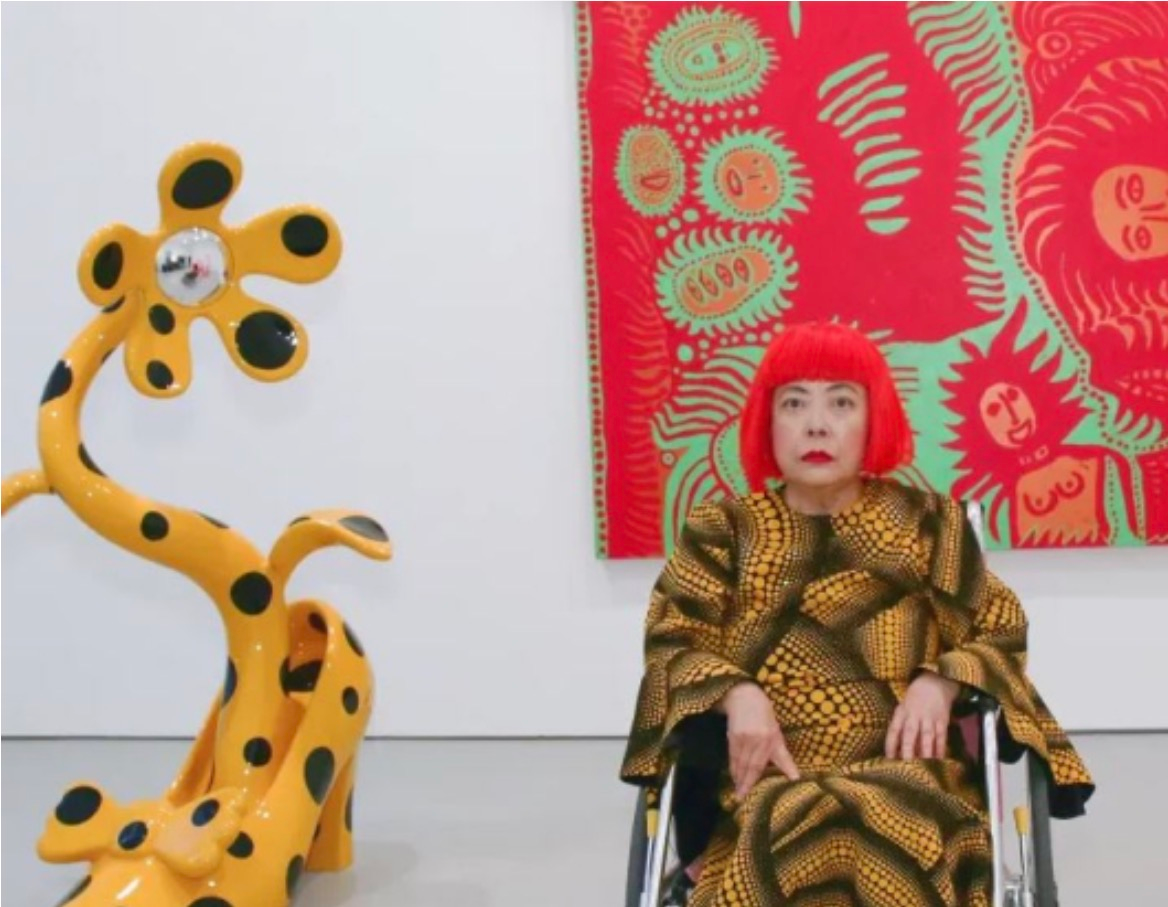
Renowned Japanese avant-garde artist Yayoi Kusama has died in Tokyo at the age of 97, The Guardian reports. According to the publication, the artist died as a result of multiple organ failure. Kusama passed away on August 14, and her funeral was held in a private ceremony attended only by close family members.
Yayoi Kusama was one of the most internationally recognized figures in contemporary art. Throughout her long and extraordinary career, she worked not only as a painter, but also as a sculptor, designer, writer and installation artist.
Her distinctive visual language made her one of the most recognizable artists in the world, while her unconventional approach to art helped transform the boundaries between painting, sculpture, performance and popular culture.

Kusama was born in Japan in 1929. At the end of the 1950s, she moved to New York, where she quickly became involved in the city’s rapidly developing avant-garde art scene. During the 1960s, she became an important figure in the development of American minimalism, pop art and performance art.
Her experimental work had a direct influence on several major artists of the period, including Andy Warhol and Claes Oldenburg. Kusama’s work challenged traditional ideas about scale, repetition, space and the relationship between the individual and the surrounding environment.
Over the decades, Kusama became one of the world’s most influential and commercially successful female artists. Her works have been sold at auctions for millions of dollars, while her large-scale exhibitions have attracted enormous crowds around the world. Her immersive installations, in particular, became international cultural phenomena, drawing visitors who wanted to experience her unusual and visually overwhelming environments from inside.
In 2008, one of Kusama’s works was reportedly sold at auction for more than $5 million, becoming a record price for the artist at the time. Her market value continued to rise in the years that followed, reflecting her growing influence on both the contemporary art world and popular culture.
One of the defining elements of Kusama’s artistic identity is her use of polka dots. Her characteristic dots cover paintings, sculptures, rooms and entire installations, often creating the sensation that the boundaries between objects and their surroundings have disappeared. For Kusama, the repetition of dots has a deeper philosophical meaning. Covering an entire space with countless dots symbolizes the merging of the individual with infinity and the disappearance of the self into a limitless universe.

This fascination with repetition and infinity became one of the central themes of her career. Her famous immersive installations often place visitors inside mirrored rooms filled with lights, patterns or repeated forms, creating the illusion of endless space. These works transformed the traditional experience of visiting an art exhibition and helped make Kusama a global cultural icon.
Behind Kusama’s remarkable artistic success, however, was a deeply difficult personal history. From childhood, she experienced mental health problems, including hallucinations and obsessive thoughts. She often described seeing patterns, dots and other visual phenomena that seemed to overwhelm her surroundings.
Her relationship with her mother was also extremely difficult. According to accounts of Kusama’s childhood, her mother frequently punished her and demanded obedience. She reportedly disapproved of her daughter’s passion for art and at times destroyed or threw away her drawings and paintings.
These experiences contributed to Kusama’s psychological struggles, which became a major part of her life and artistic identity. At certain points, her mental health problems became so severe that she came close to taking her own life.
In 1977, amid a deterioration in her condition, Kusama returned from New York to Tokyo. Since then, she spent much of her time at the Seiwa Psychiatric Hospital in Tokyo, while continuing to work as an artist. Even while dealing with serious personal difficulties, she maintained an extraordinarily productive career and continued creating paintings, sculptures, installations and literary works.
Kusama’s distinctive style eventually extended far beyond traditional galleries and museums. Her imagery became recognizable to millions of people who might not otherwise follow contemporary art. The combination of bright colors, repetitive patterns, mirrored spaces and polka dots turned her work into a phenomenon that crossed the boundaries between fine art, fashion and popular culture.

Kusama was also widely known for her high-profile collaboration with the French fashion house Louis Vuitton. The collaboration brought her iconic polka-dot imagery into the world of luxury fashion, appearing on handbags, clothing, accessories and elaborate retail installations. The partnership introduced her artistic language to an even broader international audience and demonstrated the extraordinary reach of her visual identity.
Yayoi Kusama’s career therefore represents much more than a successful chapter in contemporary Japanese art. She became a global symbol of artistic individuality, repetition, infinity and creative persistence. Her work transformed personal experiences and psychological struggles into a distinctive artistic universe that captivated audiences across generations.
With her death at the age of 97, the world has lost one of the most influential and recognizable avant-garde artists of the modern era. Her polka dots, mirrored rooms and endless patterns have become an unmistakable part of contemporary visual culture, ensuring that Kusama’s artistic legacy will continue to influence artists, designers and audiences around the world for generations to come.