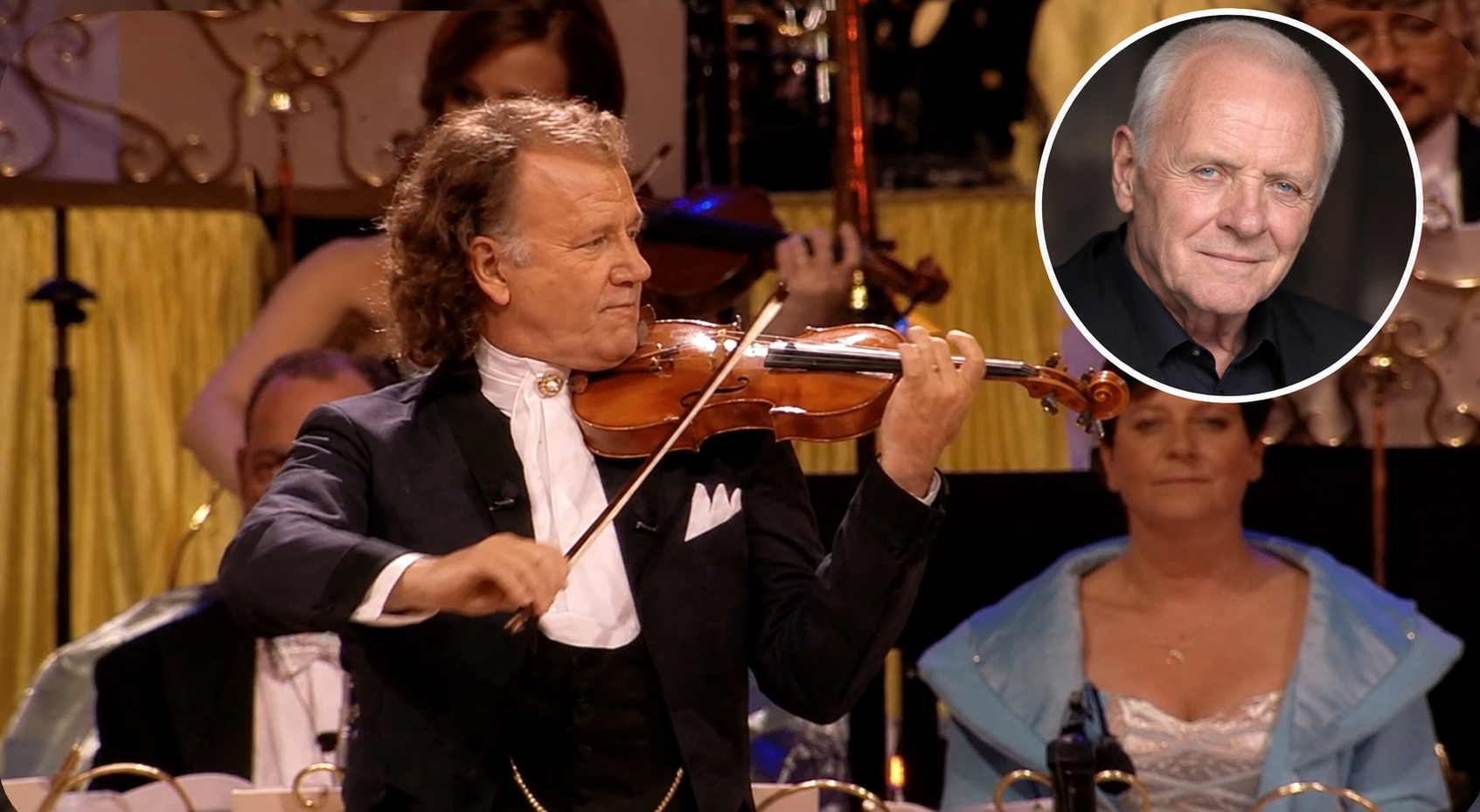
Anthony Hopkins is widely recognized as one of the greatest actors of his generation. His unforgettable performances have earned him worldwide admiration, major awards, and a place among Hollywood’s most respected stars. But long before audiences knew him as an actor, Hopkins had another passion that he quietly kept to himself.
For years, almost nobody knew that the future Oscar-winning actor had also tried his hand at composing music.
When Anthony Hopkins was young, he wrote a piece of music that would remain hidden from the public for decades. It was an emotional waltz written for an orchestra, but Hopkins was apparently too shy to share his creation with other people. Instead of showing it to musicians or attempting to have it performed, he simply kept the composition on paper.

At the time, Hopkins could hardly have imagined that his musical experiment would one day be performed before a large audience and that the story behind it would become almost as fascinating as the music itself.
Hopkins eventually became famous for his acting career, but his early interest in music never completely disappeared. The actor has spoken about his love of classical music, and his composition revealed that his connection to music went beyond simply listening to it.
The remarkable story might have remained unknown if not for Dutch violinist and conductor André Rieu.
Rieu, who is famous around the world for bringing classical music to huge audiences, eventually came across Hopkins’ composition. Rather than treating it as a simple curiosity created by an actor, Rieu recognized something special in the piece and decided to bring it to life.
The composition was arranged for performance, allowing an idea that had existed only on paper for roughly half a century to finally be heard.
There was another extraordinary detail to the story.
Anthony Hopkins himself had never actually heard his own composition performed.
For decades, the actor knew the waltz only as something he had written down. The notes existed on paper, but he had never experienced the finished orchestral version with musicians playing his work.
That changed when André Rieu and his orchestra performed the piece.
After approximately 50 years, Hopkins was finally able to hear the music he had created as a young man.
For someone who had spent his professional life performing in front of cameras and audiences, the experience must have been particularly unusual. This time, however, Hopkins was not the performer. He was the composer sitting back and listening to an orchestra interpret something that had come from his own imagination many years earlier.

The story also offers a fascinating glimpse into a lesser-known side of the actor’s personality. Hopkins is often associated with dramatic roles, intense characters, and some of cinema’s most memorable performances. Yet behind that public image was a young man who quietly sat down and attempted to create a piece of classical music.
His decision to keep the composition private makes the discovery even more intriguing.
Many people create something and immediately want to show it to the world. Hopkins apparently took the opposite approach. He wrote his waltz but did not make a public announcement about it. For decades, the composition remained largely unknown while his acting career grew.
Eventually, however, the hidden piece found its way into the hands of a musician capable of giving it the performance it had been waiting for.
André Rieu’s involvement was particularly fitting because his concerts are known for making classical music accessible to audiences around the world. His performances have introduced countless people to orchestral music, often combining traditional compositions with an energetic and theatrical presentation.
In Hopkins’ case, Rieu helped transform a forgotten page of music into something that could finally be heard.
The story is also a reminder that creative talent does not always fit neatly into one category. Someone may become famous for acting while possessing an entirely different artistic ability that remains hidden from public view.
Anthony Hopkins’ career demonstrates this beautifully. He built his reputation through acting, but his musical composition revealed another creative side that had been waiting quietly in the background.
Perhaps the most touching part of the story is that Hopkins had to wait around five decades to hear what he had created.
Imagine writing a piece of music as a young person, putting the pages away, and then spending most of your life without ever hearing it performed. Years pass. Your career changes. You become famous. Generations come and go. Then, decades later, an orchestra finally plays those notes.

For Hopkins, the moment was not simply a musical performance. It was a reunion with a much younger version of himself.
The actor who had once been too shy to share his composition eventually discovered that his musical creation had been worth hearing after all.
His hidden waltz is now remembered as a remarkable example of how creativity can survive quietly for decades, waiting for the right person to discover it.
And perhaps that is what makes the story so memorable: Anthony Hopkins spent years being celebrated for the talent everyone could see, while another talent had been sitting quietly on paper, waiting for its turn in the spotlight.
You may also like this👀👇📚
Leave a Reply