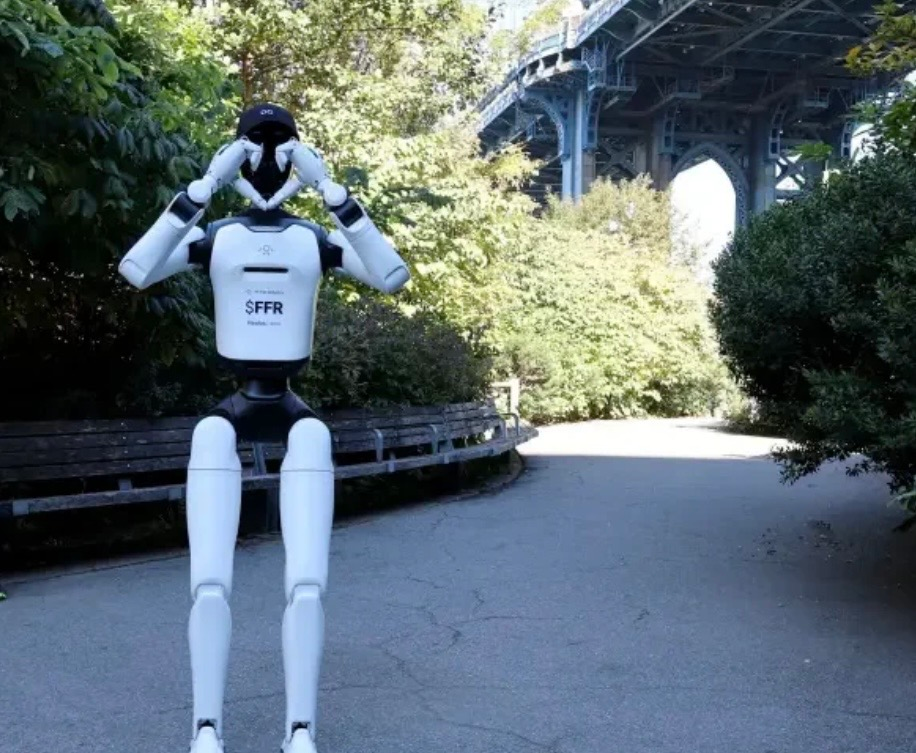
Pedestrians enjoying a walk through a New York City park were in for an unexpected surprise when they encountered an unusual visitor: a humanoid robot worth $89,000 that sang for children, danced with adults, and practiced interacting with people.
But behind the entertaining public performance lies a much more ambitious vision. Its developers hope that one day, machines like this could become babysitters, teachers, or everyday companions, according to the New York Post.
The robot was introduced by California-based company Faraday Future. On October 25, it appeared at Brooklyn Bridge Park, attracting the attention of visitors enjoying the spectacular views of Manhattan and New York’s famous bridges.
What began as an unusual sight quickly turned into an impromptu public show, with curious pedestrians stopping to watch the machine move, sing, and interact with the crowd.

Faraday Future’s Chief Technology Officer, Hong Rao, supervised the experiment and controlled the robot using a small remote-control device. According to the New York Post, the machine moved among park visitors, singing for children and dancing with adults.
Rather than simply standing still and displaying its technological capabilities, it was encouraged to engage with people in a more natural, social setting.
Some passersby enthusiastically joined the interaction. One group of approximately 12 women even gathered to take photographs with the unusual guest.
The scene attracted attention because it offered a glimpse of a future in which humanoid robots might become a more familiar part of everyday public life.
However, entertaining people was only part of the experiment.
The Ambitious Plan Behind the $89,000 Robot
The main goal of the demonstration was to help the robot learn how to interact with people in real-world environments.
While robots have traditionally been designed to perform specific industrial or technical tasks, developers are increasingly exploring ways to make them useful in homes, schools, and other places where human interaction is essential.
Faraday Future hopes its humanoid robot will eventually develop the social and practical skills necessary to assist both children and adults. According to Hong Rao, machines of this kind could potentially serve as babysitters, teachers, or companions in the future.
Such possibilities could transform the way families think about technology. A robot capable of assisting with everyday activities might help parents manage certain responsibilities, provide educational entertainment for children, or offer companionship to people who spend significant amounts of time alone.
Yet these possibilities remain long-term ambitions rather than established capabilities. The demonstration in Brooklyn Bridge Park does not prove that the robot can independently care for a child, supervise a household, or respond appropriately to every unexpected situation. During the New York appearance, it was controlled by a human operator.
That distinction is important because performing a dance or singing a song is very different from taking responsibility for another person’s safety.

Could Robots Really Become Babysitters?
The idea of a robotic babysitter may sound like something taken directly from a science-fiction movie, but advances in artificial intelligence and robotics are bringing the concept into more serious discussions.
A humanoid robot designed to work with children would need to do much more than follow simple commands. It would have to recognize potentially dangerous situations, understand changing circumstances, and respond appropriately when a child behaves unpredictably.
For example, a machine might need to recognize when a child approaches a staircase, reaches for a dangerous object, or suddenly becomes distressed. It would also need to distinguish between ordinary play and situations requiring immediate adult intervention.
Even advanced artificial intelligence systems can misunderstand their surroundings or produce unexpected responses. In childcare, mistakes could have serious consequences.
Any robot intended to supervise children would therefore require extensive testing, reliable safety mechanisms, and clear limits on what it is permitted to do.
There is also an important emotional dimension. Children often need patience, reassurance, empathy, and an understanding of their individual personalities
Although robots may eventually become better at recognizing emotions and responding conversationally, it remains uncertain how effectively they could provide the kind of care that children need.
For the foreseeable future, such machines would be more realistically viewed as potential assistants rather than replacements for responsible adult caregivers.
Would Parents Trust a Machine With Their Children?
Beyond the technical challenges, there is another major question: would parents actually feel comfortable trusting a robot with their children?
Some families might welcome a machine that helps with homework, organizes activities, reads stories, or keeps children entertained while an adult is nearby. Others may be concerned about privacy, reliability, and the possibility of a technical failure.
A household robot could also collect information about the people around it through cameras, microphones, and other sensors. Developers would need to address how this information is processed, stored, and protected, particularly when children are involved.
Trust would depend not only on how intelligent a robot appears but also on whether its behavior is predictable, its limitations are transparent, and its safety systems can be relied upon.
The $89,000 price tag presents another potential obstacle. Even if humanoid robots become practical household assistants, such a high purchase price could put them beyond the reach of many families. Their long-term success would depend on affordability as well as usefulness and safety.

A Glimpse Into the Future of Robotics
The appearance of Faraday Future’s robot in Brooklyn Bridge Park illustrates a broader shift in the development of artificial intelligence. Instead of remaining confined to computer screens, digital assistants, and automated systems, AI-powered machines are increasingly being designed to interact with people in physical environments.
Public demonstrations allow developers to observe how people respond to robots outside controlled laboratory settings. They can reveal how easily a machine attracts attention, whether people are willing to approach it, and how it performs when faced with unpredictable surroundings.
Nevertheless, there is still a considerable gap between a robot that can entertain a crowd and one that can safely take responsibility for a child. Moving from one stage to the other will require substantial advances in engineering, artificial intelligence, and safety testing.
For now, Faraday Future’s $89,000 humanoid robot is best understood as a demonstration of what future technology might make possible, rather than a ready-made solution for modern households.
Still, the experiment raises an intriguing question: if robots eventually become capable of assisting with childcare, education, and companionship, how much of everyday human life will people be willing to share with machines?
The answer will depend on more than technological progress. It will also depend on whether these robots can earn people’s trust, demonstrate genuine practical value, and prove that they can operate safely in the unpredictable world of human relationships.
You may also like this article👇📚👀