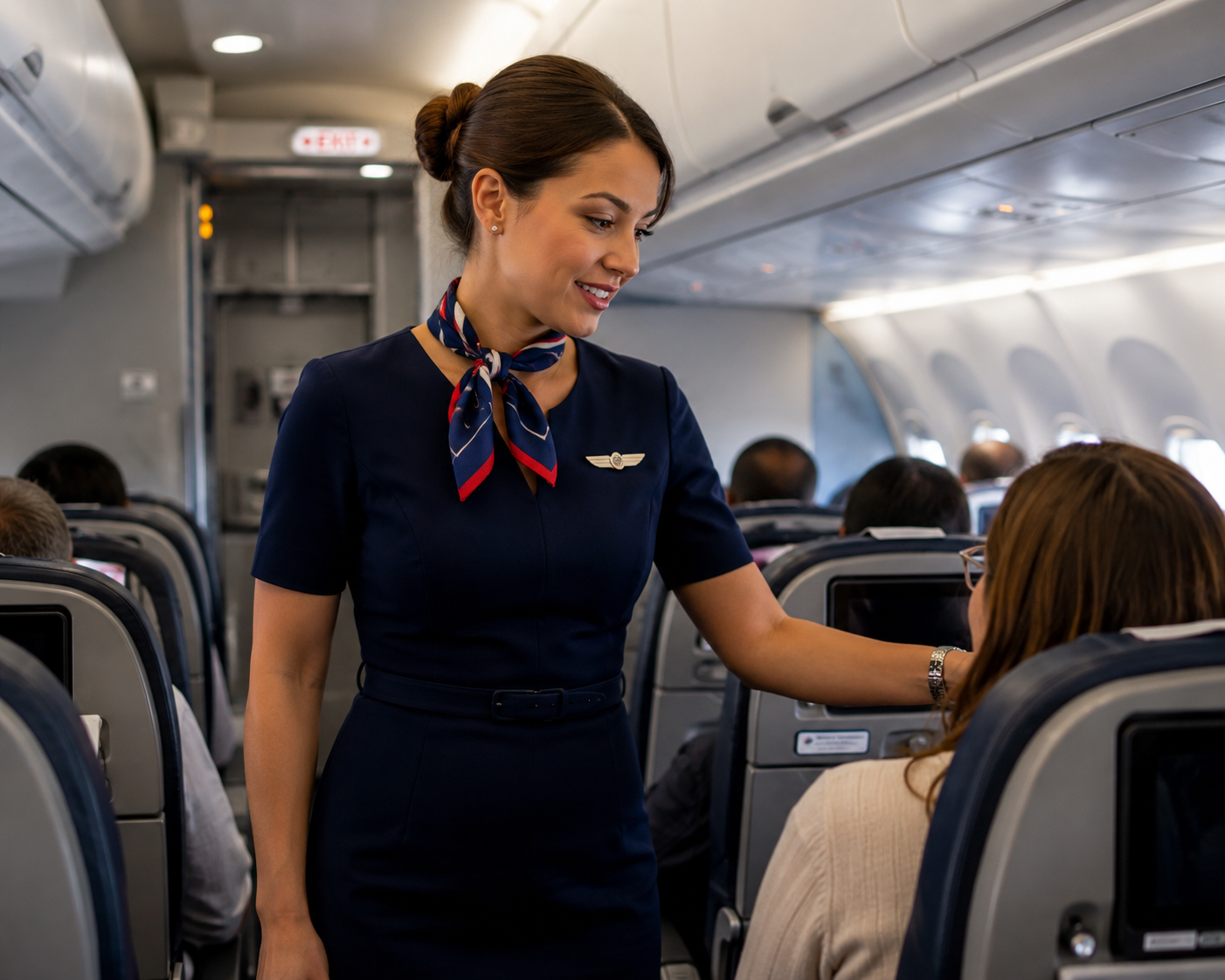
Flight attendants have an important warning for all passengers: when flying, you may want to think twice before wearing clothing that leaves your legs exposed for the sake of personal hygiene. According to The Independent, airline crew members strongly advise passengers to avoid sitting on airplane seats with bare skin whenever possible.
Charity Nelms, a former contestant on the reality show Survivor 48 who worked as a flight attendant for 11 years, has issued a particularly strong warning about wearing shorts, skirts, and dresses while traveling by plane.
“I’m telling you this as a flight attendant: you have no idea what I have seen on these seats,” Nelms said in a video posted to TikTok.
Her advice was simple: wear long pants whenever you fly.
“Wear pants. No shorts, no skirts, no dresses. Just long pants,” she urged. “You do not want your bare skin touching that seat. It doesn’t matter if you think you are disinfecting it. No, no, no. Wear pants. Trust me, I have seen some absolutely demonic things.”

Nelms’ comments quickly drew attention online, particularly because airplane seats are used by hundreds of passengers over relatively short periods of time. While airlines have cleaning procedures in place, the amount of time available between flights can vary significantly, meaning that not every part of the cabin receives a deep cleaning after every flight.
Another flight attendant, Cher Killough from Dallas, Texas, has issued a similar warning specifically concerning shorts and exposed skin.
In one of her accounts, Killough described an incident that she said demonstrated just how unpleasant airplane seats can become during a flight.
“Guess how many diapers were changed on the seats during one of my flights yesterday? Four,” she said. “Guess how many of them had poop in them? All four. Right on the seat. And you want to rub your bare skin on that afterward?”
Her comments highlight an aspect of air travel that passengers rarely think about: the cabin is a shared environment where people eat, sleep, cough, sneeze, change babies, spill drinks and sometimes become sick.
How Are Airplane Cabins Actually Cleaned?
So, how clean are airplane cabins between flights?
The reality is that most aircraft undergo a relatively quick cleaning process during the short period between flights. According to John Alford, vice president of ABM Aviation, an aviation services and cleaning company, this type of cleaning generally focuses on removing trash and cleaning the most obvious areas of the aircraft.
The process typically includes areas such as galleys, lavatories, passenger areas and other parts of the cabin where visible waste needs to be removed.
However, this should not necessarily be confused with a deep cleaning.
After longer flights, usually those lasting around eight to 10 hours, and when aircraft remain overnight, they can undergo what is known as overnight cleaning.
“This type of cleaning is more thorough, focusing on passenger areas around the seats,” Alford explained.
A much deeper cleaning process is performed far less frequently. Alford has compared it to the detailed cleaning of a car, where seats and certain interior components may be partially removed so that areas that are normally difficult to reach can also be cleaned.
This means that the seat you are sitting on may have been cleaned, but it does not necessarily mean that every surface has been disinfected immediately before you boarded the aircraft.

Other Areas of an Airplane That Can Be Dirty
Nelms also pointed to another surface inside the aircraft that passengers should consider cleaning before using it: the seat belt.
According to the former flight attendant, both the metal buckle and the fabric portion of the seat belt can come into contact with a wide range of contaminants because so many passengers handle them.
“The metal part, because everyone touches it,” she explained. “And the fabric part of the belt should be wiped down too, because it is constantly being pulled.”
She warned that passengers may not realize how many different substances can end up on seat belts during repeated flights.
“Imagine how much vomit, baby poop, bodily fluids and spilled drinks end up on these belts,” Nelms said, urging passengers to wipe them down before using them.
Another area she highlighted was the airplane lavatory.
Nelms advised passengers not to walk around the aircraft bathroom wearing only socks, and certainly not to go barefoot.
“Never walk into the bathroom in your socks, guys,” she warned. “There is never just water on that bathroom floor. Your socks act like two giant sponges.”
The warning is particularly relevant because airplane lavatory floors can come into contact with water, spilled liquids and other substances throughout a flight. Since socks absorb moisture and come into direct contact with the floor, passengers can potentially carry whatever is on the floor back to their seats.
What Should Passengers Do?
The overall message from the flight attendants is not that passengers should be terrified of flying, but that a few simple precautions can make the experience more hygienic.
Wearing long pants can create a physical barrier between your skin and the airplane seat. Wiping down frequently touched surfaces, such as the seat-belt buckle and tray table, can also be a sensible precaution, particularly for passengers who are concerned about hygiene.
And when using the airplane bathroom, wearing shoes rather than walking around in socks or barefoot is an easy habit to adopt.

Airplane cabins are cleaned regularly, but the level and timing of cleaning can vary depending on the aircraft, airline, flight length and turnaround time. A quick turnaround between flights does not allow cleaning crews to perform the same level of detailed cleaning that is possible when an aircraft has several hours or an entire night on the ground.
So, what is the main takeaway?
You do not need to become paranoid before boarding your next flight, but being a little more cautious about hygiene may be worthwhile. Wear pants when possible, wipe down frequently touched surfaces, and keep your shoes on when visiting the lavatory.
After all, you will probably never know exactly what happened on that airplane seat before you arrived. And, judging by the stories shared by experienced flight attendants, perhaps that is one mystery of air travel that is better left unsolved.
You can also read this📚👇