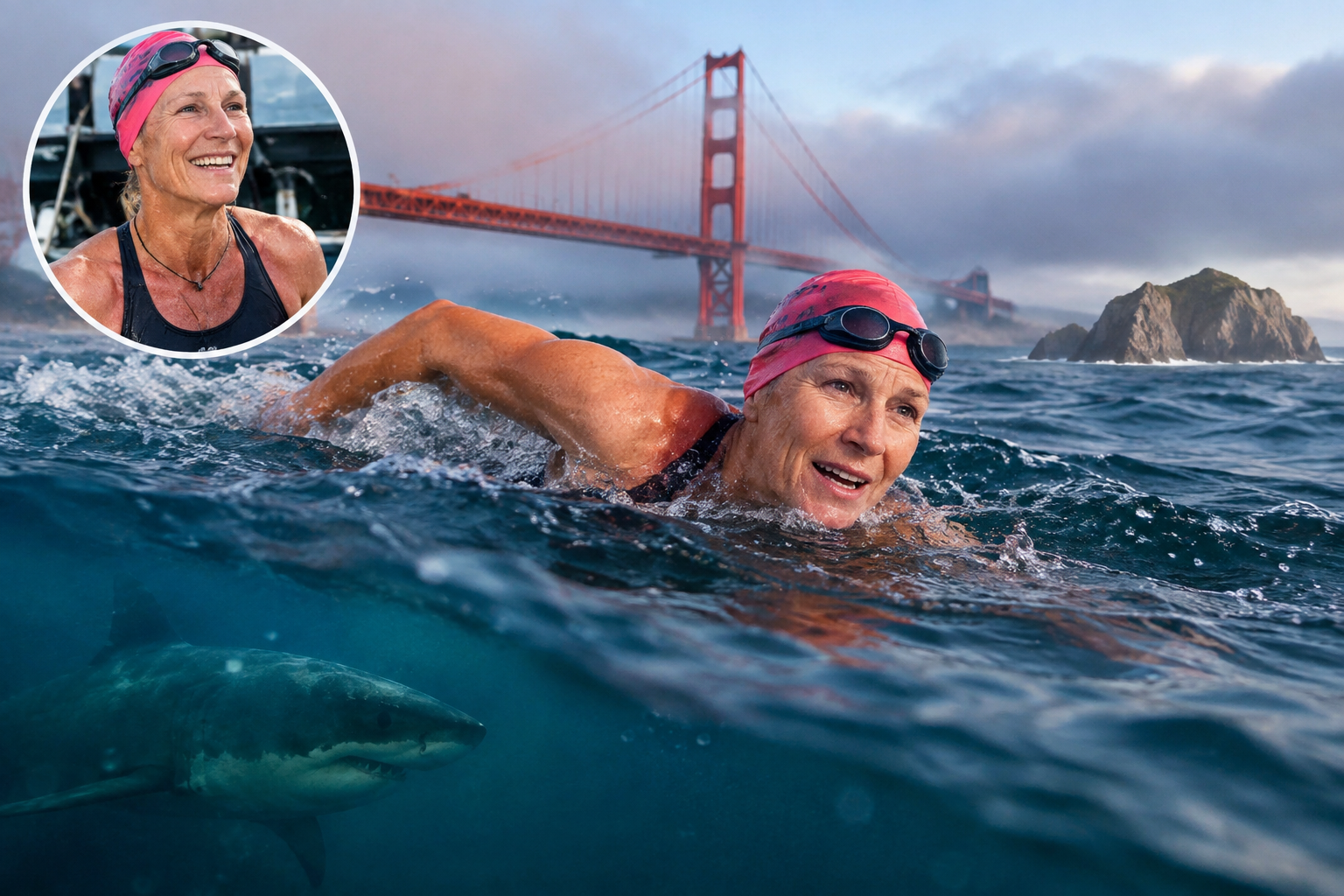
A grandmother has defied expectations about age and body weight by completing an extraordinary swimming challenge that could make her the first woman to swim from San Francisco’s Golden Gate Bridge to the Farallon Islands, a distance of nearly 30 miles.
Amy Appelhans Gubser, a former collegiate swimmer from Pacifica, California, had not swum seriously for 24 years before deciding to return to the water and train for one of the most demanding open-water challenges imaginable.
Her journey was far more than a test of endurance. She had to deal with freezing ocean temperatures, thick fog, poor visibility, jellyfish and the constant knowledge that great white sharks were swimming in the surrounding waters. And she completed the entire challenge without wearing a wetsuit.

Gubser entered the water near her support vessel at 3:27 a.m. and began what would become an approximately 17-hour swim. She continued through the day and eventually reached the Farallon Islands after nightfall.
The Marathon Swimmers Federation, or MSF, monitored the attempt through an observer. Her record is still awaiting official verification, but if confirmed, the achievement would be historic. Gubser would become the first woman to complete the swim and the first swimmer of either sex to successfully travel in the outbound direction, from the Golden Gate Bridge toward the Farallon Islands.
Two men have previously completed the distance, but they began their swims from the islands and traveled toward the mainland. Gubser accomplished the challenging route in the opposite direction after three previous attempts had failed under MSF observation.
The conditions she faced during the swim were particularly difficult. Gubser told Fox News Digital that fog and red tide created an almost surreal environment around her. For much of the journey, she could see only a few feet in any direction when she lifted her head above the water.
Under the surface, visibility was even worse. She said she could not see even an inch beyond her fingertips.
For most people, swimming for hours in water known to be frequented by great white sharks while barely being able to see their surroundings would be terrifying. Gubser, however, managed to maintain her concentration by entering what she described as a “meditative state.”
Every 30 minutes or so, her rhythm was briefly interrupted for a snack break. She would take in food and fluids before returning to her steady swimming pace.
“I really had to be very thoughtful and careful about how I approached this swim because of the sharks,” Gubser explained.

The timing of the attempt was also carefully considered because of shark activity in the region. According to Gubser, a major migration of great white sharks takes place between April and June as the animals move away from the Farallon Islands. That seasonal pattern is one reason the swim needs to be attempted during that period.
Gubser also had a specific reason for choosing not to wear a wetsuit.
“When you wear a wetsuit your skin rubs against the material, and the last thing that I really wanted was for my skin to bleed near a shark island,” she said.
The water was brutally cold when she began. Temperatures were in the high 40s Fahrenheit, roughly 7 to 9 degrees Celsius. Over the course of the swim, the water gradually became warmer by about 10 degrees Fahrenheit.
Despite the cold and exhausting conditions, Gubser maintained a remarkably consistent pace. She averaged approximately 61 strokes per minute throughout the journey.
Keeping her energy levels up was another important part of the challenge. During the swim, she consumed chicken broth, canned peaches, hot chocolate and potatoes. These regular feeding breaks helped her maintain enough energy to continue swimming for hour after hour.
The ocean also presented another unexpected obstacle. Gubser was stung by jellyfish on two separate occasions during the journey. Nevertheless, she continued swimming and refused to allow the painful encounters to stop her attempt.
What makes her accomplishment particularly remarkable is that she had spent more than two decades away from serious swimming before beginning her preparations.
Returning to a demanding sport after 24 years and then preparing for an almost 30-mile ocean crossing required enormous physical and mental commitment. The challenge demanded endurance, careful planning, discipline and the ability to remain calm under extraordinary circumstances.
But Gubser says she hopes her story will mean more than simply setting a swimming record.
She wants her accomplishment to inspire people who may believe that age, body weight or the passage of time prevents them from pursuing ambitious goals.
Her journey demonstrates that athletic achievement does not necessarily have an expiration date. A person can step away from a sport for decades, return later in life and still set an enormous challenge for themselves.
After approximately 17 hours in the Pacific Ocean, surrounded by cold water, heavy fog, limited visibility, jellyfish and waters known for great white sharks, Gubser finally reached the Farallon Islands.

If officially verified, her achievement will become an important milestone in open-water swimming. But regardless of the final record status, her journey already carries a powerful message: age and body size do not have to define what a person is capable of achieving.
For Gubser, the nearly 30-mile swim was not simply about reaching another island. It was about proving that extraordinary goals can still be pursued when you are willing to prepare, endure and keep moving forward, one stroke at a time.
You can also read this 📚👇
Leave a Reply